How serious teams evaluate coding agents in 2026
A practical guide to testing coding agents before they silently break production.
Lead memo
A coding agent is not reliable because it solved one issue in a demo. It is reliable when you can change the model, prompt, tool set, or repo and know whether the system got better or worse.
That is the difference between "we tried it on my repo" and an engineering system. The first creates confidence theater. The second creates a quality loop.
This matters because AI coding is no longer a fringe workflow. Enterprise money has moved into coding tools, developers use AI tools heavily, and teams are putting agents into production. But the trust gap is still real: developers are using these systems while also questioning whether the output is accurate enough for complex work. [11], [12]
The bottleneck is not only model intelligence. It is measurement. LangChain's 2026 agent survey reported that production agent adoption is already real, while quality is the leading production blocker and eval adoption lags behind observability. [1] That gap tells you where the next serious engineering discipline is forming.
So this issue is about the operating system for trust: public benchmarks, house tasks, trace review, and release gates. You do not need a paid API bill to understand the system. You need a clear answer to three questions:
- What should the agent accomplish?
- How do we know it did it correctly?
- What changed after we altered the model, prompt, tools, or environment?
Why this matters now
Coding-agent evals are becoming a practical operating concern, not a research side quest. The timing is strong for three reasons:
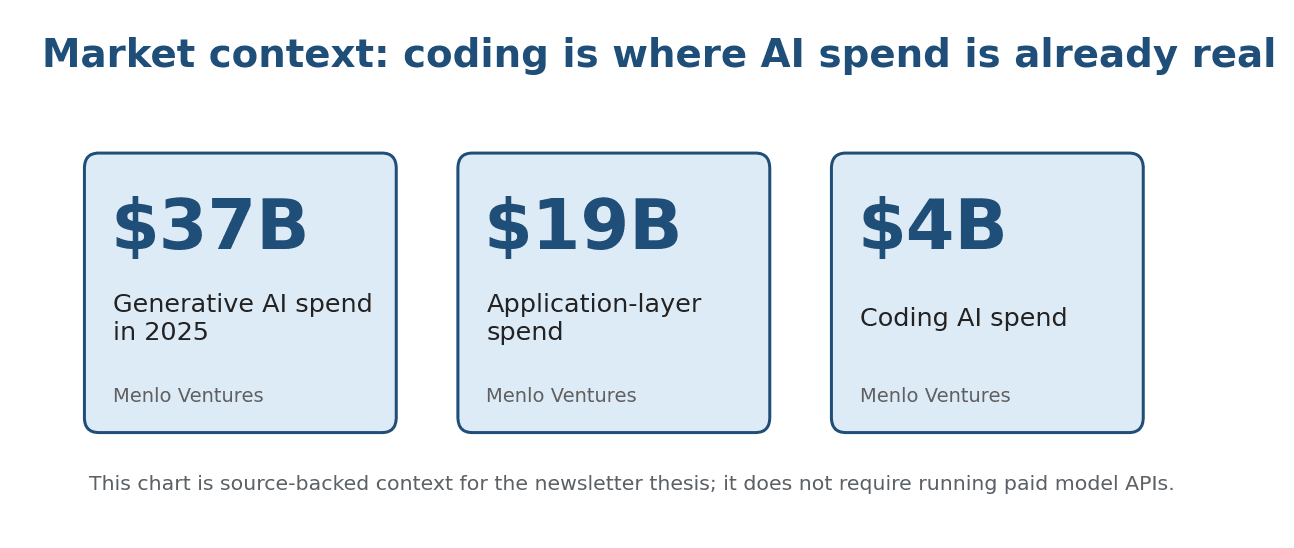
- Coding is already one of the breakout AI application categories. Menlo Ventures estimated 2025 generative AI spend at $37 billion, with $19 billion going to the application layer and $4 billion going to coding-related tools. [12]
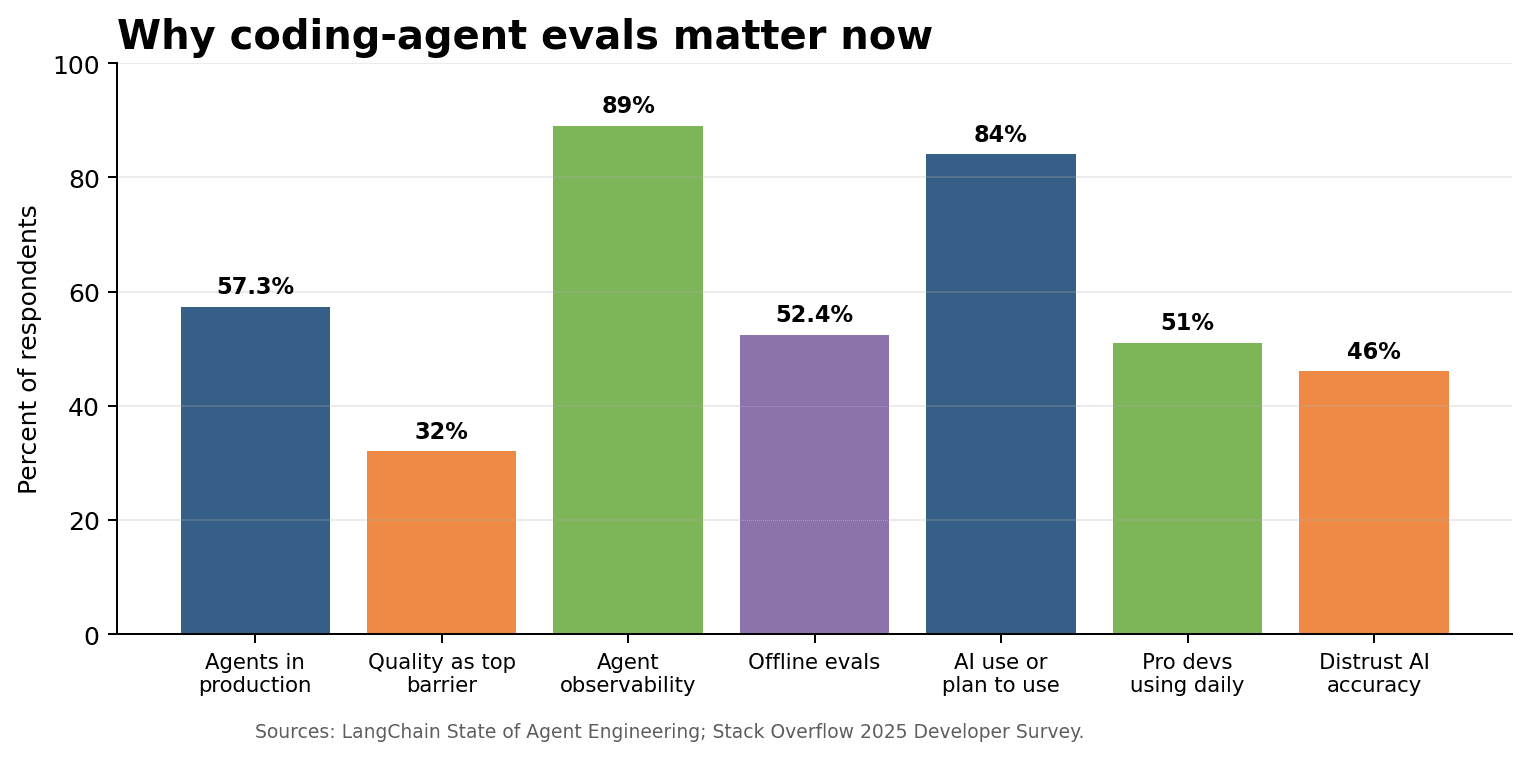
- Developers use AI heavily but remain skeptical about accuracy. Stack Overflow reported that 84 percent of respondents use or plan to use AI tools, 51 percent of professional developers use them daily, and 46 percent distrust AI output accuracy. [11]
- Agent adoption has moved into production while quality remains the hard problem. LangChain reported that 57.3 percent of surveyed organizations already have agents in production, quality is the top production blocker, and observability adoption is ahead of eval adoption. [1]
Three things changed
1. Agent adoption moved from lab to production
LangChain surveyed more than 1,300 professionals and reported that 57.3 percent already have agents in production, with another 30.4 percent actively developing toward production. The question has shifted from whether agents will ship to how teams make them reliable. [1]
2. Quality is now the practical bottleneck
The same survey puts quality above cost as the main production blocker. For coding agents, translate that into: does the patch work, does it avoid regressions, and did it make the system safer or riskier? [1]
3. The tooling layer is formalizing around traces and evals
OpenAI has expanded agent tooling around datasets, trace grading, prompt optimization, and graders, while Anthropic argues that agent evals need code-based, model-based, and human graders. [2], [3], [5], [6]
The mistake: treating a benchmark score like a deployment decision
Public benchmarks are useful. They give the market a common language. SWE-bench Verified asks whether a system can resolve real GitHub issues from popular Python repositories, and Terminal-Bench measures whether agents can complete end-to-end tasks inside terminal environments. [7], [10]
But a benchmark is not your product. It does not know your repo structure, security rules, flaky tests, product standards, code review culture, customer tolerance, or rollback process. It also may not stay clean forever. OpenAI now warns that SWE-bench Verified has become less suitable for measuring frontier coding progress because of flawed tests in a hard subset and evidence of training-data exposure. [9]
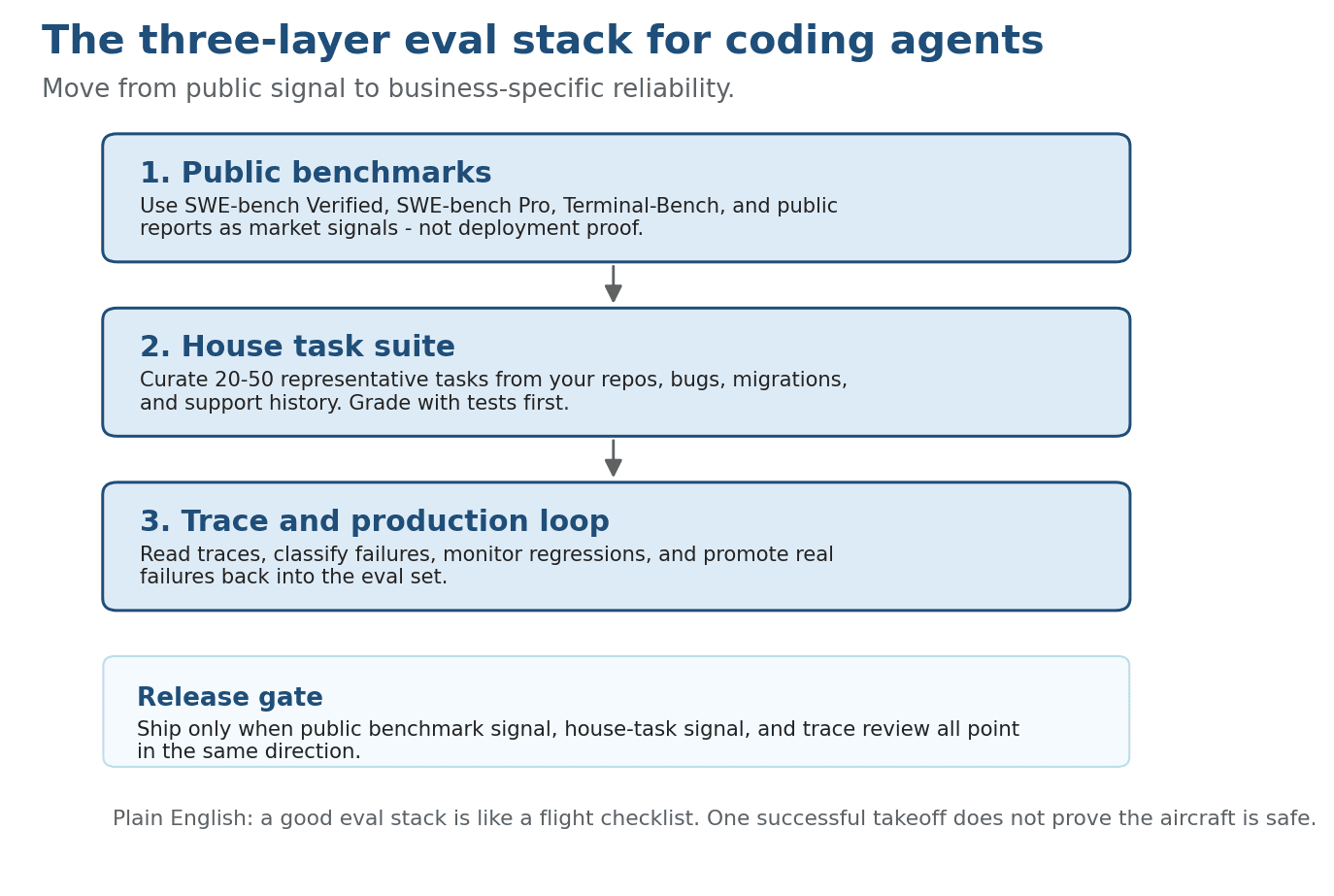
The right move is not to ignore benchmarks. The right move is to put them in their place. Use public benchmarks for market orientation. Use your own tasks for product truth. Use production traces to discover what neither of those sources predicted.
The practical stack: three layers, not one scoreboard
Layer 1: Public benchmarks
Use SWE-bench Verified, SWE-bench Pro discussions, Terminal-Bench, and other public reports to understand broad capability movement. This layer answers: what can current systems do in standardized environments? It is helpful for editorial framing, but it should not be the only evidence behind a recommendation. [7], [9], [10]
Layer 2: House tasks
Build a small dataset from your actual work: bugs that hurt users, migrations that are annoying but repeatable, test failures that junior engineers can fix, config changes with clear acceptance criteria, and refactors where regressions are easy to detect. Anthropic recommends starting with 20 to 50 simple tasks from real failures rather than waiting until you have hundreds. [2]
Layer 3: Traces and production feedback
A trace is the record of what the agent did: model calls, tool calls, handoffs, guardrails, and decisions. Trace grading lets you inspect not only whether the output passed, but why it passed or failed. OpenAI frames trace grading as a way to score an end-to-end agent trace against structured criteria and find regressions or failure modes at scale. [5], [6]
How to start without paying for API calls
You can design a useful starter eval system without paying for model API usage. The key is to start from evidence your team already has: coding-assistant sessions, pull requests, bug reports, failed CI jobs, and manual experiments.
The first useful eval suite can be a spreadsheet and a GitHub Actions workflow. Paid model reruns are optional later, not required on day one. What matters first is disciplined task selection, clear acceptance criteria, and a habit of turning real failures into future regression checks.
| Need | Free or low-cost option | What it gives you |
|---|---|---|
| Task source | Issue tracker, past PRs, failing tests, support tickets | Realistic tasks tied to actual product pain. |
| Correctness grading | Unit tests, integration tests, type checks, linting, static security checks | Objective signals without judge models. |
| Trace review | Manual review of transcripts or logs exported from existing tools | Human understanding of why failures happen. |
| Score tracking | Spreadsheet, CSV, or markdown table in the repo | A baseline you can compare over time. |
| Automation | GitHub Actions, local Docker, pytest, ruff, mypy, bandit, shell scripts | Repeatable checks that fit existing workflows. |
What serious teams actually measure
A useful coding-agent eval has more than a pass/fail column. Pass/fail tells you whether the final output cleared the bar. It does not tell you whether the agent took a fragile path, burned too many tokens, made risky edits, skipped tests, or required human rescue.
| Metric group | Example metrics | Why it matters |
|---|---|---|
| Correctness | Task pass rate, unit-test pass rate, reference-solution agreement | Measures whether the agent solved the stated problem. |
| Regression safety | Pass-to-pass tests, changed public APIs, security checks, dependency drift | Measures whether the fix broke something else. |
| Process quality | Tool calls used, skipped tests, unnecessary rewrites, trace review outcome | Shows whether the agent behaved like a careful engineer. |
| Operational cost | Runtime, token cost if available, retries, wall-clock time, compute cost | Prevents wins that are too slow or expensive to use. |
| Human review | Reviewer intervention rate, severity of reviewer edits, false confidence cases | Captures trust and handoff cost. |
Benchmark matrix
| Evaluation source | What it measures | Best use | Caveat to state clearly |
|---|---|---|---|
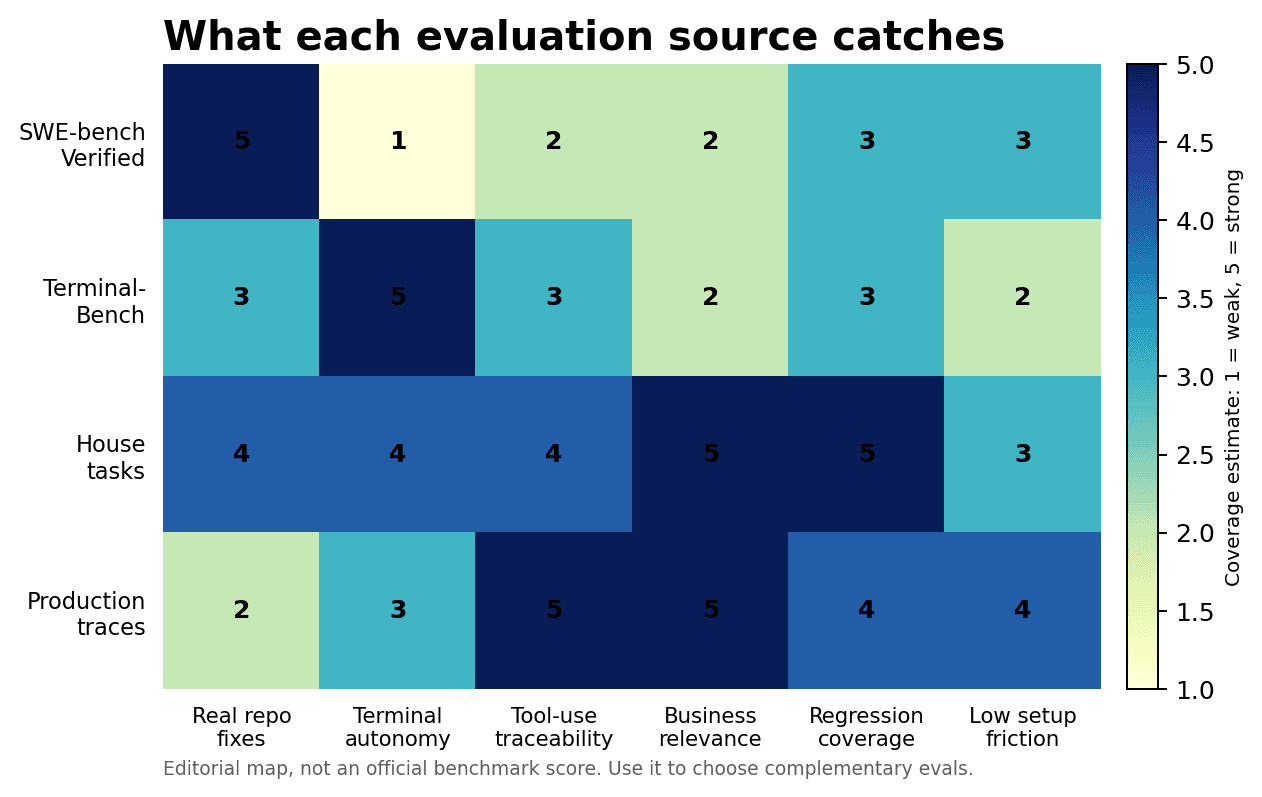
| SWE-bench Verified | Real GitHub issue resolution from a human-filtered 500-task subset. | Understand why real-repo tasks are more meaningful than toy prompts. [7], [8] | OpenAI warns it is increasingly contaminated and may reject valid solutions in a hard subset. [9] |
| Terminal-Bench | End-to-end tasks in terminal environments, including system, data, security, and ML workflows. | Check whether agents can operate through a terminal, not only generate patches. [10] | Scores depend on scaffold, sandbox, tools, and task distribution. |
| House tasks | Product bugs, migrations, refactors, tests, and review standards. | Measure whether an agent is useful on the work your team actually ships. | Small sets can be biased. Start small, then grow from real failures. |
| Production traces | Tool calls, errors, retries, handoffs, and decisions. | Explain why a run passed or failed, then turn surprises into regression tasks. [5], [6] | Traces require human reading and classification, not just storage. |
Failure taxonomy: the part readers will save
| Failure class | Plain-English symptom | Technical signal | How to catch it |
|---|---|---|---|
| Wrong fix | The code changes but the user problem remains. | Fail-to-pass tests fail; reference behavior missing. | Unit tests, integration tests, acceptance tests. |
| Regression | The agent fixes one thing and breaks another. | Pass-to-pass tests fail; unrelated module changes. | Regression suite, API contract tests, diff review. |
| Test gaming | The agent satisfies the test but not the real requirement. | Hardcoded outputs; brittle fixtures; suspicious minimal edits. | Hidden tests, code review, adversarial examples. |
| Scope creep | The agent rewrites too much or invents architecture. | Large diffs, new dependencies, changed public interfaces. | Diff budget, architectural rules, human review. |
| Tool-use error | The agent skips files, calls the wrong tool, or ignores test output. | Trace shows missing read, missing test run, or bad arguments. | Trace grading, required tool checks, transcript review. |
| Environment failure | The task fails because sandbox or dependencies are broken. | Repeated infra errors across unrelated tasks. | Clean containers, pinned dependencies, reference solution run. |
| Security regression | The fix creates a vulnerability. | Static analysis warnings, auth bypasses, unsafe dependency changes. | Security tests, SAST, threat-model review. |
| False confidence | Everything looks green, but reviewers still do not trust it. | High automated score but heavy reviewer edits. | Reviewer calibration and sampled human grading. |
Starter scorecard template
Use this as the practical takeaway. It is intentionally simple enough to copy into a spreadsheet.
| Column | What to record | Example |
|---|---|---|
| Task ID | Stable task name | repo-auth-001 |
| Task type | Bug fix, refactor, migration, test fix, performance, security | Bug fix |
| Prompt/task | The exact instruction given to the agent | Reject empty password during login. |
| Expected outcome | What must be true after the run | Empty password returns 400 and logs auth_blocked. |
| Graders | How success is measured | pytest, mypy, bandit, human trace review |
| Failure class | Taxonomy label if it fails | Wrong fix / regression / scope creep |
| Cost/time | Run time and token cost if known | 11 min; cost unknown |
| Reviewer notes | Human judgment and next action | Patch works but over-edits middleware. |
No-paid-API harness sketch
eval_tasks:
  - id: repo-auth-001
    task: "Reject empty passwords in login without changing existing success path."
    repo: "internal-auth-service"
    start_commit: "abc123"
    setup: "uv sync && uv run pytest tests/auth -q"
    acceptance:
      - "uv run pytest tests/auth/test_empty_password.py -q"
      - "uv run pytest tests/auth/test_success_path.py -q"
      - "uv run bandit -q -r src/auth"
    trace_review:
      must_check:
        - "Agent read the auth handler before editing."
        - "Agent ran the focused test and at least one regression test."
        - "Agent did not introduce a new dependency."
    scoring:
      correctness: 0.45
      regression_safety: 0.25
      process_quality: 0.20
      reviewer_confidence: 0.10
Free starting point:
- Run these checks against a patch created by any coding assistant or human.
- Save the result in a CSV.
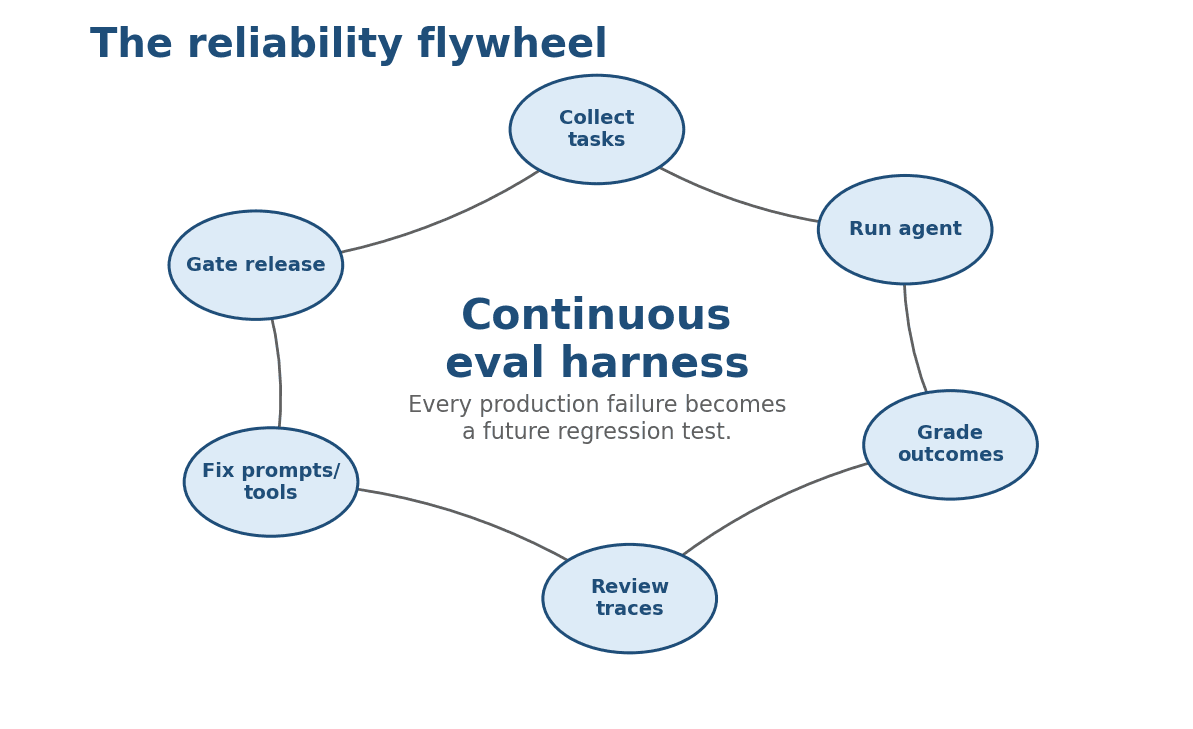
- Promote every serious failure into a new regression task.
Release gate checklist
- Run the static house-task suite before changing a model, prompt, agent scaffold, or tool set.
- Read at least five passing traces and five failing traces after each meaningful change.
- Compare correctness, regressions, runtime, retry rate, and human intervention rate against the previous baseline.
- Require human approval for security-sensitive, data-migration, payment, authentication, compliance, or dependency changes.
- Do not ship if pass rate improved but reviewer edits increased or trace quality got worse.
- Promote any severe production failure into a permanent regression task within the same week.
- Keep benchmark claims separate from product claims.
Bottom line
The teams that win with coding agents will not be the teams with the longest prompt. They will be the teams with the best feedback loop.
That loop is not glamorous: tasks, tests, traces, rubrics, review, and release gates. But it is the difference between a tool that occasionally impresses engineers and a system that can be trusted inside real software delivery.
Public benchmarks tell us the frontier is moving. House evals tell us whether the frontier matters for our work. Production traces tell us what we missed. Use all three.
Market context and glossary
Terms without jargon
| Term | For technical readers | For non-technical readers |
|---|---|---|
| Coding agent | An LLM system that can inspect repos, call tools, edit files, run commands, and iterate. | An AI assistant that can work on software tasks with some autonomy. |
| Eval | A structured test of model/system behavior against explicit criteria. | A repeatable quality check. |
| Trace | A run log of model calls, tool calls, handoffs, guardrails, and outputs. | The audit trail of what the AI did. |
| House task | An internal evaluation case from your own repo or workflow. | A test based on the work your team actually does. |
| Regression suite | Tests that catch previously fixed failures when the system changes. | A memory bank of mistakes you do not want repeated. |
CTA for readers
Send one coding-agent failure you wish your eval suite had caught earlier using the form below. I will turn the best examples into a public failure taxonomy in a future issue.
References
[1] LangChain. State of Agent Engineering. 2026.
[2] Anthropic Engineering. Demystifying evals for AI agents. Jan. 9, 2026.
[3] OpenAI. Introducing AgentKit. Oct. 6, 2025.
[4] OpenAI API docs. Evaluation best practices. Accessed Apr. 24, 2026.
[5] OpenAI API docs. Agent evals. Accessed Apr. 24, 2026.
[6] OpenAI API docs. Trace grading. Accessed Apr. 24, 2026.
[7] SWE-bench. SWE-bench Verified. Accessed Apr. 24, 2026.
[8] OpenAI. Introducing SWE-bench Verified. Aug. 13, 2024; updated Feb. 24, 2025.
[9] OpenAI. Why SWE-bench Verified no longer measures frontier coding capabilities. Feb. 23, 2026.
[11] Stack Overflow. 2025 Developer Survey - AI. 2025.
[12] Menlo Ventures. 2025: The State of Generative AI in the Enterprise. Dec. 9, 2025.
[13] DORA / Google Cloud. State of AI-assisted Software Development 2025. 2025.